The Asian Pacific Islander Desi American Panel at the UW-Madison Diversity Forum: Invisible No More!
Part 1 of 2
By Jonathan Gramling
Since its inception over 20 years ago, the Diversity Forum put on by UW-Madison’s Division of Diversity, Equity and Educational Achievement has always been inclusive on some level or another, oftentimes in the smaller workshops held in the afternoon or on the second day. Asian Pacific Islander Desi Americans, APIDAs, have rarely been in the spotlight of the main activities on the first day.
But in the spring of 2020 after the COVID-19 pandemic hit and demagogues like President Donald Trump labeled it the “China Flu,” there was a noticeable uptick in aggressive behavior, physically and verbally against perceived Chinese people no matter what Asian country they were from. And this racist behavior occurred on the UW-Madison campus with anti-Asian graffiti being written among other micro-ggressions. The APIDA students became active.

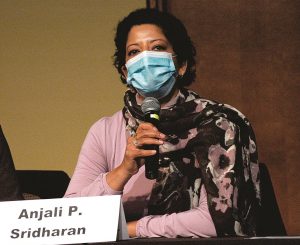
Professor Lori Lopez (l) and Anjali Sridharan were two of the APIDA faculty, staff and students who spoke at the UW-Madison Diversity Forum on November 1st.
“This has all happened in the last year,” said Anjali Sridharan, a researcher on campus. “Students pushed for the center. I didn’t even know about that until after the Diversity Forum when I went out to dinner with a panelist and the two organizers. Kevin Wong, Natalie Chin, Rebecca Johnson and I were the coordinators of the panel. We went out to dinner. And then Tev Lee who runs the student center was also at dinner with us. That’s when he said, ‘Oh yeah, there was a push from students to have a student center that focused on their people.’ And that’s how it came to be. I don’t know if they were protesting or complaining or just brought it to people’s attention. Whatever they did, it worked. It was in short order. I don’t think it took that long from the time they actually voiced their concern to the actual student existing, I don’t think it was that long.”
And the students — and many people across the United States — became more inclusive with the term that refers to “Asian Americans.”
“If in some form or survey they ask what your background is, if they say Asian American, I feel like I don’t belong in that group because automatically people think East Asians,” Sridharan, who is of Indian (subcontinent) background. “Even I do. Nowadays, underneath that, they have a bunch of categories to identify the subcategories underneath it. And that’s when I say, ‘Okay, yes I do fit that now.’ But the APIDA is a shocker for me in a good way. I was like, ‘What is this APIDA thing?’ They had just said something about a student center opening and I happened to read it. And I was like ‘What? Desi American, where did this term come from?’ I read it at home and I called a colleague of mine. I was like, ‘Did you see that article?’ They said, ‘Yeah.’ ‘Did you see that it’s called this?’ ‘Yeah.’ ‘Did you know that was opening?’ ‘Yeah, there was an announcement about that student center opening.’ ‘Do you know what that means?’ All of my colleagues in my little group are all white Americans. I don’t think they realized how big of a deal it was for me until I made such a big deal about it. Then they were like, ‘Okay.’ I never felt that we were ever called out in a good way. So I felt people actually acknowledged that we exist.”
And this heightened activism reached the people planning the UW-Madison Diversity Forum held in-person at Union South’s Varsity Hall and virtually on November 1 and only virtually on November 2. The focus on APIDA issues was a welcome change for the APIDA community.
“I don’t think that APIDAs have ever been on a main panel in the 13 years I’ve been at UW-Madison,” Sridharan said. “Not only that, I don’t think until this past six months has anyone really been at the leadership of the DDEEA at UW-Madison who is not African American, which I totally get. I never questioned it. I totally get this country’s history. I was never upset by it. A couple of years ago, I was like the DDEEA is no longer in its infancy at UW-Madison. It’s a well-oiled machine. Patrick did a phenomenal job. I was like, ‘Okay guys, you need to diversify your diversity group.’ Then when Anju Reejhsinghani, a good friend of mine, became assistant vice-provost in DDEEA — her daughter and my daughter were running around and picking up cards at the Diversity Forum — I was like, ‘Okay, I’m seeing some change.’ I’m 100 percent sure — Anju is a former professor — she had some influence on the choice of Russell Jeung as the keynote. I don’t know that for a fact, but I have a good feeling about that. She’s pretty well in tune with what is going on in the country. That along with Natalie Chin having a negative experience in Superior, Wisconsin where she worked for UW-Madison culminated in this panel. Anju had nothing to do with our panel. We put it together and then pitched it. It was timely.”
Russell Jeung, a professor at San Francisco University and a co-founder of Stop AAPI Hate that was established to document anti-Asian incidents in the United States at the start of the pandemic was the keynote speaker on the first day. Jeung presented the historical to the present place of APIDA people and the violence and discrimination that they experienced, oftentimes outside of the glare of the national media. And then Sridharan and others served on a panel of APIDA faculty, staff and students that highlighted the diversity within the APIDA community.
“We wanted ours to be a very positive panel, an introduction,” said Sridharan. “We didn’t want to focus on the negativity that has been brought about over the last two years. We wanted to focus on the diversity of APIDA people on campus. From top to bottom, we exist. We were not new. We are also part of the cloth that holds together the administration, the facilities, the faculty, and the staff all over campus in all different jobs. Except for Assel Almuratov who came from Kazakhstan and Yeshe Gyatso who came from Tibet, no one else really had an accent. We’re all from here. We are really American, born and brought up in America. I wanted people to realize that we are not new. We all have different backgrounds, but because we look different from the classic European American, people are wondering where we are coming from. As soon as we open our mouths, they are like, ‘Oh my gosh, they are one of us.’ I wanted people to know that we are just as much a part of faculty and staff and students as everyone else. We fit in. And we should be accepted.”
Dr. Lori Lopez, a UW professor and chair of the Asian American Studies Program, also reflected on the diversity.
“I think it was pioneering,” Lopez said about the panel. “It did seem to be something that the panel organizers were striving for, to give a really multifaceted representation of APIDA identities. Any discussion that you have about racial identity is going to be where you ask people how they identify racially. You think that you’re getting a bunch of people who identify as one thing. What that racial identity means to them all is going to be very different. If you gathered any five people whom you think identify as APIDA, they will probably tell similarly different stories from each other. Some people will think that the identity fits them perfectly and is very important to them. Some people will feel that it doesn’t fit them at all or isn’t important to them. And then there is everything in between. It just feels that every racial group is going to have those kinds of diversity experiences.”
Sridharan talked more about the panel’s diversity.
“We wanted to vary where there heritage is from and what their job is,” Sridharan said. “And it wasn’t that hard. It was easy. There were that many people that it was easy to find people in all of these positions. When we were talking about what our backgrounds were and Natalie said her mother’s side is part Japanese, Chinese and French Canadian, I was like, ‘Really?’ As soon as you see Natalie Chin, you think Chinese. And then Rebecca with the name Rebecca Johnson is blond-haired and green eyed. And yet all of her features are Korean. That’s another kind of diversity. And then there is me who looks 100 percent Indian. Yes, I have a definite connection to India and the culture because I was brought up with parents who grew up in India. But I would rather talk to my husband about Brady Bunch than the latest Bollywood movie coming out. I don’t watch Bollywood movies unless someone goes, ‘This is an unusually good movie.’Maybe I will consider it. I’m American for all intents and purposes.”
Next issue: Diversity and Unity