


Former UW Badger Montee Bell Authors 'Nowhere to Run': Running on Empty

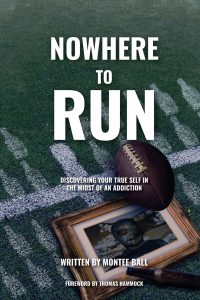
Former Badger and Denver Bronco Montee Bell wrote about his fall from grace due to alcoholism in Nowhere to Run now available at www.monteeball.com.
By Jonathan Gramling
Montee Ball now has two reasons to be called great. As most of us know in Madison and Wisconsin, Ball was a famed running back on the UW Badger football team from 2009-2012. Ball holds the NCAA single season records for most touchdowns: 39 tied, most consecutive games with two or more touchdowns: 13, most points scored by non-kicker: 236 and the career record for most touchdowns: 83.
Ball now is also great for writing “Nowhere to Run: Discovering Your True Self in the Midst of an Addiction,” — which should be required reading for collegiate student athletes — which chronicles Ball’s fall from greatness to the bottom, only to realize his most meaningful purpose in life.
In many ways, it was a fall bound to happen. Ball grew up in Wentzville, MO and earned all-state honors and national attention during his high school career. Ball said that he basically ate, slept and lived football. Football was his entire life.
The seeds for alcoholism were there at an early age. Hall’s father had been an alcoholic although he had been sober since Ball was three-years-old. By the time Ball was a sophomore, he was a high school football prodigy and getting a lot of attention. And he was trying to fit in against his parents’ advice as it related to alcohol
“When I was experimenting with alcohol in the later part of high school, I was just doing it because it was what the ‘cool’ kids were doing,” Ball said. “I wanted to be a part of the ‘cool’ kids group. I still understood that I needed to stay in school and keep my grades up to obviously pursue my athletic career. I knew that I had to stay focused on my schooling. I was still on the straight and narrow.”
It was during Ball’s sophomore season at UW-Madison that he began to rise through the ranks to become the UW Badger featured running back. And with fame, comes footfalls that can make you stumble.
“Being the ‘Big Man on Campus’ at the time, everyone wants to party with you,” Ball said. “I really started to drink and get into it. Everyone is calling for extracurricular activities that obviously revolve around alcohol.”
But the drinking began to transition to self-medication as the pressures began to build.
“I was no longer drinking just to fit in,” Ball said. “I was no longer drinking just to be with the ‘cool’ kids and be able to chime in on their stories of late night festivities. It was now making me feel good. It was now allowing for me to worry less. There was less stress. There were the daily stressors of football, student athlete, familial
pressures, and societal pressures. And I felt alleviated when I was under the influence. So that is when my relationship shifted from drinking for fun to self-medication.”
The pressure was relentless souring the one thing that Ball was passionate about since he was a kid.
“I struggled with fans running up to me when I would go to the grocery store and when I would try to do my daily things,” Ball said. “I got a little bit withdrawn. I pulled away from folks because in a nutshell, I kind of got tired of talking about football 24/7, every single minute of my entire day. I respected every single fan who came up to me and respected their curiosity. But imagine talking about your job 24/7 every single minute of the day, even when you are at home and it’s the first thing you do when you wake up. It gets tiring.”
Ball’s increasing reliance on alcohol was masked by his athletic conditioning and abilities.
“I almost wish that there were moments in my collegiate career, sophomore, junior and senior seasons where I would have been able to pinpoint a moment in time where I said, ‘Okay, the drinking is causing my performance to be less,’” Ball said. “But unfortunately it didn’t. My performance was only increasing. It was only on its way up on an incline, so there was no red flags to stop me. And so being in good shape, being in top shape still running two miles every other day after practice just to keep my weight down, it was almost like, ‘Okay, I guess I am doing everything right.’ It was a very slow process of going from my first drink to my mental state during my last drink. It was a very long, drawn-out process of heading towards rock bottom.”
While Ball knew who he was as a football player, he didn’t really know who he was as a person because it had been football 24/7. And that led to a lot of personal identity confusion.
“I was like, ‘I’m just doing what everyone else is doing here on campus,’” Ball said. “Am I really struggling with alcohol?’ That’s what everyone I saw was doing. Even some football players was involved in it too. I had that split and I was confused at a very impressionable stage of my life. I didn’t really understand where all of the pieces of the puzzle were falling. ‘Am I doing something wrong?’ The citizen Montee was just going to class and partying like every other student in college. Or is this something that is going to come back and bite me in the butt. Is this something that is stopping me from being the best I can be on the field? We know the answer to that question, of course. Now we do.”
By his senior year in 2012, Ball had or would break many Wisconsin, Big 10 and NCAA records and won the Doak Walker Award as the nation’s top running back. In the 2013 Rose Bowl, Ball became the first player to score a touchdown in three consecutive Rose Bowls. Ball was at the top of his game. Little did he realize then that he was poised for a big fall.
Ball was drafted in the second round of the 2013 NFL draft by the Denver Broncos. Ball did okay in 2013, rushing for 559 yards and four touchdowns. But the heavy drinking continued.

“Everything escalates once you get to the NFL,” Ball said. “Everything is bigger. You have more money. You’re on national news, etc. It’s just lights, camera, and action. So it came to where people in my circle were only in my circle because of what they gained. I was paying for everything. I was making sure they were taken care of. I was doing everything I needed to do to make myself feel better. But essentially, what I was doing was giving away parts of my soul and alcohol continued to push me down to rock bottom.”
But it was in his second season in 2014 that Ball’s alcoholism caught up with him as he was no longer that naturally gifted athlete in the prime of his life.
“Everything caught up to me, not taking care of my body off the field, the drinking, not sleeping, staying up late, etc. Physically, first my appendix went out and then three weeks later, I tore my groin. That pushed into further depression because at that moment, I started to realize that I wasn’t taking care of my body. And so tearing my groin was what was expected. It hit me really quick. Once that moment in 2014, the 2015 season came about and they released me right before the season started. I was upset with myself. I was very angry at myself.”
Ball had begun his professional fall.
I was fortunate enough to get picked up by the Patriots for about 6-7 weeks,” Ball said. “I actually had a pretty good time out there in Massachusetts. But again before I hopped on the Patriots, I was on the fence of going back into the NFL or not because I really needed to address my drinking. But then I had the media. I had friends. I had everyone else trying to push back into the direction of the NFL and I wanted to go back too. This was all I knew was being a football player. Outside of football, I didn’t really know who I was. So I went back. The Broncos team that released me beat the Patriots in the AFC Championship Game and went on to play the Panthers in the Super Bowl. It was tough.”
Next issue: Rock bottom and redemption