


A Behind the Scenes Look at Defining Characters from an Actress of Color Point of View at American Players Theater: Evolving Nuances on Traditional Roles (Part 1 of 2)
By Jonathan Gramling
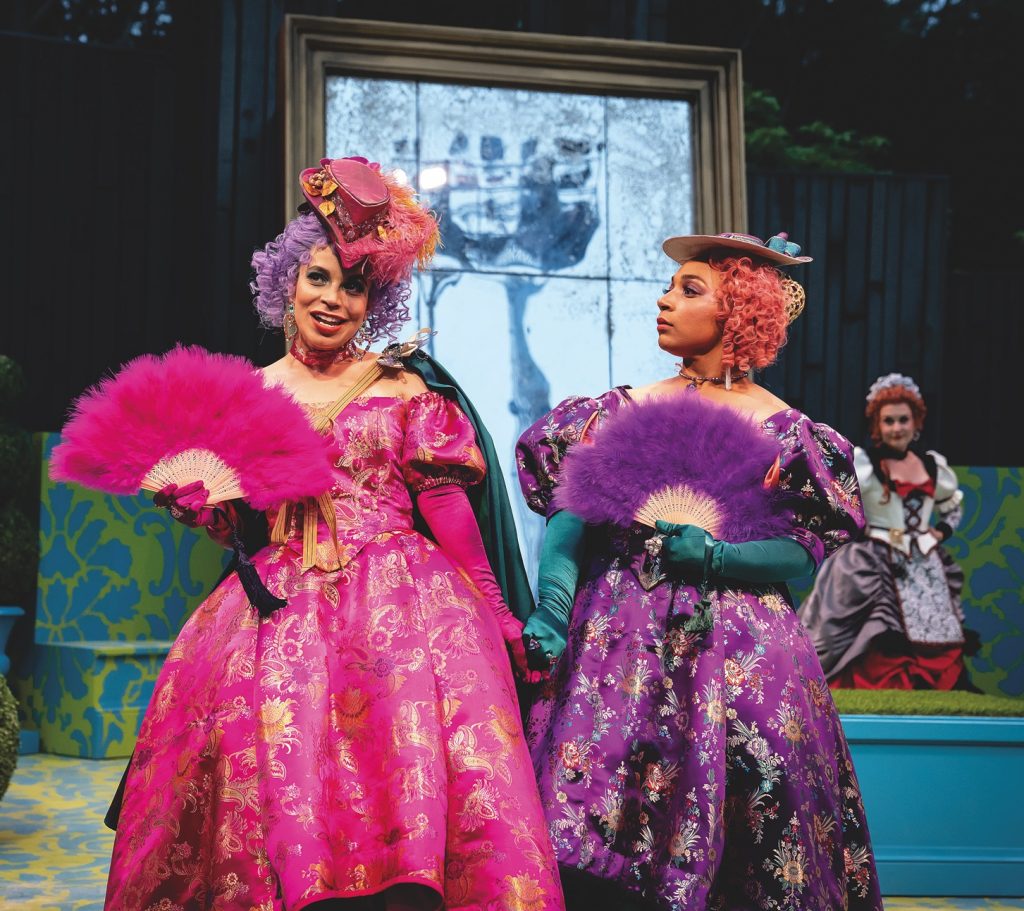
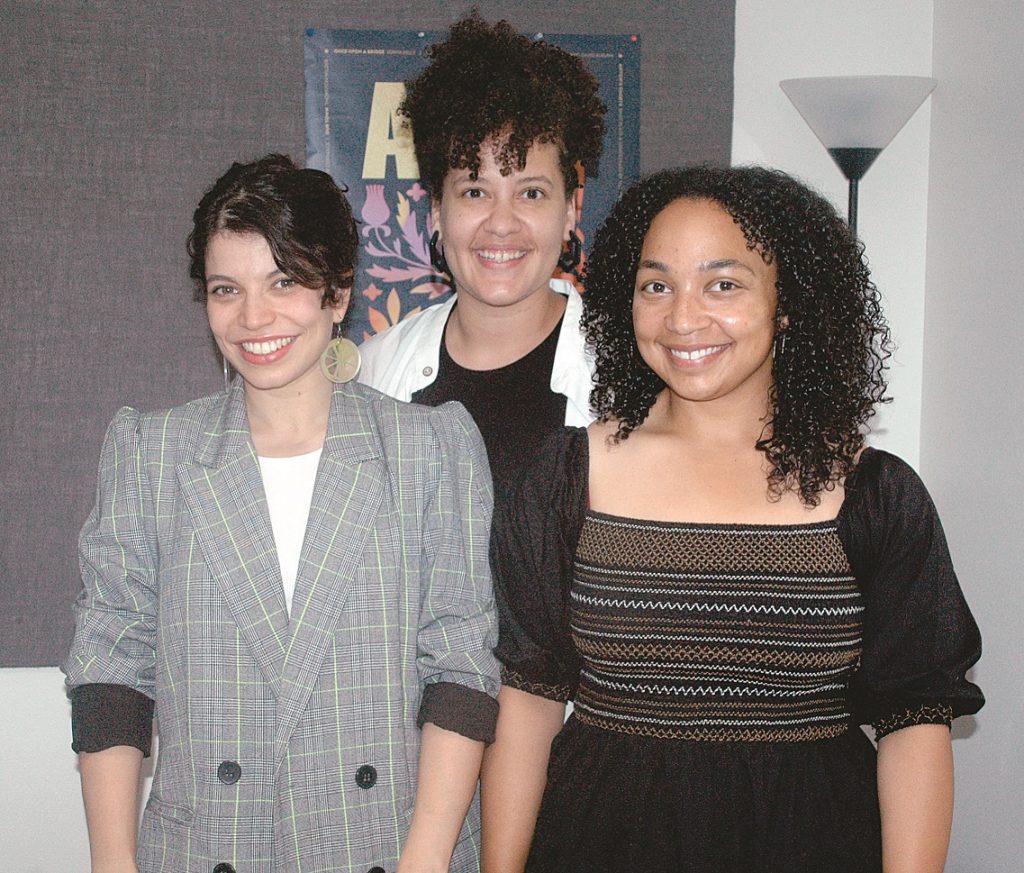
Upper left: Phoebe González (l-r), Alys Dickerson and Samantha Newcomb; Upper right: Phoebe González (l-r), Samantha Newcomb & Kelsey Brennan, The Liar, 2023. Photo by Liz Lauren
The American Players Theater, located in the wooded hills east of Spring Green, is nationally known for its Shakespearean productions as well as for its production of new works. APT was founded in 1977 in Washington, D.C. and it wasn’t until 1988 that APT bought the land it now sits on and began to build several theaters including an outdoor amphitheater and a smaller indoor theater.
APT has a national reputation for also reimagining Shakespeare so that the bard’s works — without changing the dialogue or scenes — relevant to contemporary audiences. It has also begun to produce more plays written by playwrights of color, especially August Wilson pieces. It has also brought several actors of color into its core cast with Samantha Newcomb becoming the first Black woman to become a member of the core. And Alys Dickerson, who first came to APT as an actress, is now their artistic associate.
“A big part of my job is working with our young, early, career actors and the apprentice program,” Dickerson said. “I help cast. I help read plays. I help place them in those plays and then another part of my job — I'd say 30 percent of my job — is the understudy system that we have here. So making sure that any actor who's covering another role in a different show — we do nine shows at a time — and everyone's covering another character in a different play so I help them run lines. I help them remember blocking. I help them recall the music and the dance. I’m just making sure that none of our shows get canceled because the show always has to go on and things do happen over the course of five months about. I think COVID kind of set us into a reality check with that because our understudy system is only two years old. I think like a couple years ago, it was like a wing and a prayer. You just hoped that someone had played the role for and there was time to put them in, but COVID happened and folks, you know, started getting sick and we had to keep doing the shows, you know? So we have a little bit more of structure this year.”
And it was COVID, sort of to speak, that landed her the artistic associate job.
“I was living in Chicago and was slated to play Porsche out here in Julius Caesar and then COVID happened,” Dickerson recalled. “And all the theaters were shutting down. Everyone was halting their seasons and I was getting ready to move out here when COVID happened. All the paperwork had been signed when COVID happened. I said, ‘Hey, I don't have a job and I still need a place to live.’ When I was talking to Brenda Davita, the artistic director, she was like, ‘We have the space. We have apartments. We have spaces where you can quarantine, come on up here.’ So how I started living here was because of COVID. I had no other place to go to be honest. So they housed me for six months during the pandemic. And then post George Floyd, they started an education program, a racial fluency program. That gave me a job. I got to help build that program, which is still something that the theater is doing and executing. So this place is the reason I survived the pandemic. And the reason I got a little better at my administrative life was that along with my artistic life, I also worked the education portion of it.”
Samantha Newcomb came to thneater early.
“I started my journey in theater and acting when I was a kid,” Newcomb said. “I would do stuff at the Children's Theater. I'm from Portland Oregon, I would just have the children's theater there and then I did stuff in high school and was the president of the drama club and all that. So it seemed kind of inevitable that I would study it in college. I went to school in Chicago and a lot of folks from Chicago end up here at APT. So that's how I ended up here at APT just a couple years out of undergrad. My first year was also 2019. And I was introduced to this place through Gavin Lawrence who's also in the core company. He had seen me in a couple of shows in undergrad and made introductions for me to this place.”:
But Newcomb’s APT career was almost short-lived when COVID struck the next year.
“It really just turned so many things on their head,” Newcomb said about COVID. “And for a while, there was no job, right? And all of us go contract to contract. So all of us had our contracts booked out through the summer through whatever. And that was suddenly gone along with our places to live. I was supposed to come up here. I ended up going home to live with my parents for a year in Portland. And then not knowing how theater specifically was going to come back was tough because it seemed like we would never be able to gather and that is what theater is. There are other mediums that were able to continue. We developed our tickets plays for a while, you know, things like, on screen because you can have some distance for that.”
Newcomb stayed connected with APT virtually.
“I started watching APT during the virtual season,” Newcomb said. “I was reading some plays and so I would like sit at home watch those. I couldn’t wait to be back. It was just so uncertain for a long time. I was trying to figure out if we would ever make it out of this time, COVID-wise. Will this job still be here in the same way? And what would we need to make a pivot? I didn't know if I was going to go back to acting to be honest. I didn't know if it would exist in the same way. But then in 2021 there was an amended season that we were part of where instead of working in rep — like we always do — with a bunch of COVID protocols in place, we did one play at a time. And we had masks. We were separate. And we did one play fully closed to others. We fully closed it just keep everyone safe. So, I did come back for that season which felt, honestly, like a miracle. And I don't know if I've ever experienced people feeling so excited to go to work. It had been a year to a year and a half since people had done a play. And I still am experiencing now in rehearsal people saying, ‘This is my first playback or this is my first in the year or two since then.’ Yeah, there's a new level of gratitude for being able to be together in person.”
While Newcomb grew-up on the West Coast, Phoebe González grew up in New York City.
“I'm very proud to have two artists parents,” González said. “My dad is a visual artist and a teacher, and my mom was an actor for many many years before. They were not necessarily anticipating raising an artist kid, but in retrospect, it feels kind of inevitable. I saw an ad for an audition of a production of Free to Be You and Me and I was eight years old. It was at my local community theater in a church and I showed up and learned I could sing and that I liked to be on stage. And the rest is history. I mean, I took a similar path. I was definitely a theater kid in high school. I studied acting and playwriting and musical theater in college. And then I fell in love with the theater scene out in Chicago. I thought I was going to be doing. black box, kitchen sink, family dramas for the rest of my life and like perform in the Chicago storefront theater scene. And then I came to this place and discovered the world of classical theater that built a relationship to nature. I discovered how good it feels to work surrounded by people at the top of their game all the time and yeah that was back in 2018 and I keep coming back here ever since.”
González recalled the gradual way that APT came back from the COVID pandemic. It was tiny steps back to normalcy.
“There's a thing that happens when there's intimacy in a scene anyway like if there's kissing or if there is some kind of touch that communicates history, while you are getting to know yourself in the story and you're getting to know your co-worker and your co-workers who are around bearing witness, you might rather than on day one, ‘We're going to kiss,’ put a placeholder that may or may not be a physical touch and then you work up to the actual moment of intimacy,” González said. “So during COVID, it was kind of like an expanded version of that of the first most protected level was we were all rehearsing in N 95 masks and not really touching and then after a bunch of testing and after checking in with our COVID Safety Officer Sarah Young, and then at the time and looking at the numbers in the area. Maybe we the actors can rehearse without masks but all of admin and all of our stage management team and directing team is going to keep a mask on and then we the actors have taken off our masks. Provided everyone is comfortable, you can move forward with the physical contact but it was, it was touch was scary at that time. There's still a degree of fear around it. I mean, it's not like COVID just disappeared. I had gratitude for being back in a space and being able to do theater again as it was meant to be done.”
