

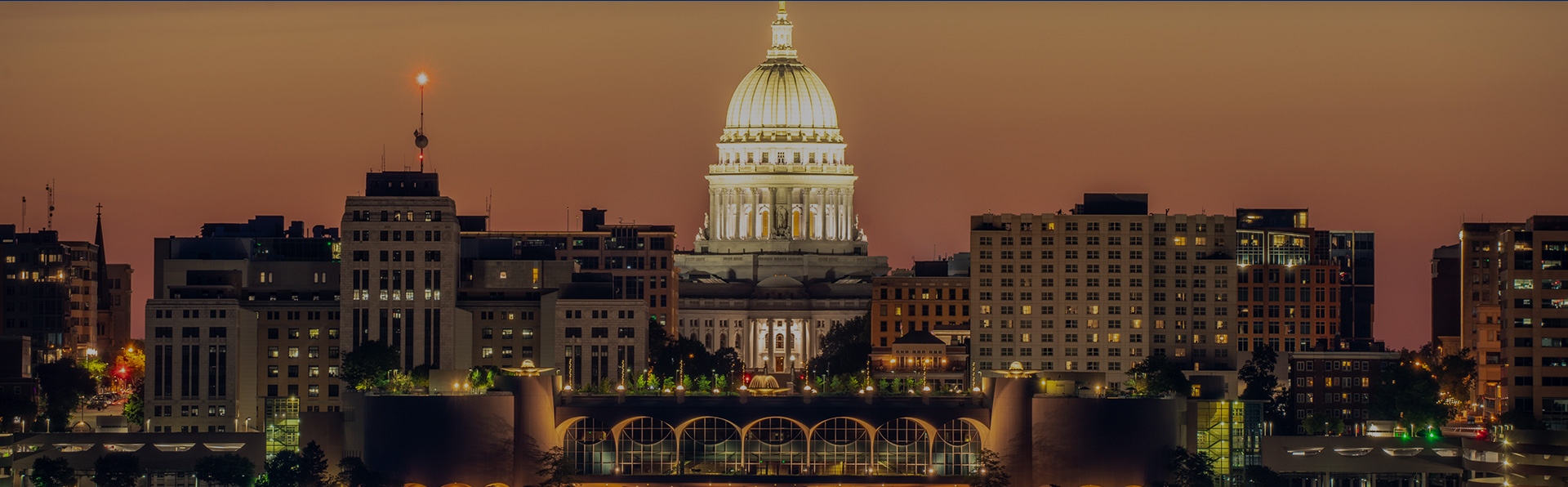
Graduation at the University of Wisconsin – Madison: Building a Collegiate Career

Andres Bañuelos-Perez
by Jonathan Gramling
For Andres Bañuelos-Perez, for his early years, life was tough.
“Our family was economically challenged,” Bañuelos-Perez said. “My parents came to the United States from Mexico. They started from ground zero. They stayed with my aunt, who was the first in the family to come over here. My aunt helped them get situated. The first couple of years, it was both my mother and my dad working. It was pretty tough. I was born and raised in Madison. When I was starting out in kindergarten, I was in the Northport area living in an apartment. We were constantly moving from one apartment to another apartment.”
What made it tolerable was the free events and activities that Madison had to offer.
“I would say it was pretty nice growing up in Madison,” Bañuelos-Perez said. “It was nice because I always found things to do. There was always nice stuff to do like go to the zoo and other kinds of stuff. I think overall, I was really happy with Madison and its winters too because I was a kid who loved snow and liked sledding and all of that.”
Eventually, a housing opportunity came the Bañuelos-Perez family’s way that offered them stability.
“Fortunately, there was the organization called Habitat for Humanity,” Bañuelos-Perez said. “We bought a low-cost house. That really helped us find a stable place. That’s why in my middle school and high school years, I didn’t really move around.”
Another stabilizing factor was Bañuelos-Perez’s introduction to the UW-Madison PEOPLE Program while he was at Sennett Middle School. He almost didn’t make it in.
“At first when I heard about the PEOPLE Program, I was like, ‘Oh, it sounds really nice, getting the opportunity to go to college with tuition paid for and stuff,’” Bañuelos-Perez said. “My parents said that I should sign up for it because it was a great opportunity. But I didn’t know what was going on. I had a delay in getting the application and all of the required materials in. I remember it being the very last day where I could submit everything. And that’s when I finally decided to act on it. And I was like, ‘Hopefully, it’s not too late to apply for this program.’ That very last day, I talked to one of my teachers and asked him for a letter of recommendation at the last minute. ‘I know it’s last minute, but if at all possible, could you give me a letter by the end of the day?’ I’m really thankful it all worked out. A lesson learned there is not to do stuff last minute. That could have really affected my role down the road. It could have been life changing.”
Through PEOPLE, he was exposed to UW-Madison for the first time.
“In middle school, we went downtown, the university area, and we would be part of the summer program,” Bañuelos-Perez said. “I really enjoyed that summer program. It kind of felt like summer school because we got to learn about math, about language arts, about science, all different kinds of subjects. On top of that, we got to meet people from different schools from all over Madison and Milwaukee. It was nice connecting with those students. Overall, I really enjoyed the sense of community. It was nice going to the university buildings and imagining yourself being there one day. It was nice preparing for college.”
The next stop on Bañuelos-Perez’s academic journey was La Follette High School.
“I would say overall, it was really nice,” Bañuelos-Perez said about La Follette. “I really loved the teachers there. They always motivated the students. It seemed they were there for a purpose, for the students and to teach. I also got to meet a lot of amazing people there, really nice friends, people I still talk with today. Overall, it was nice. There were times though I remember when I went there, there were a lot of fights. There was a time when there was a shooting right outside the school and they brought in metal detectors. That was kind of weird. But overall, besides those mishaps, it was a really fun experience there.”
And his high school PEOPLE experiences kicked into a higher gear.
“You received tutoring for various classes,” Bañuelos-Perez said. “I always found that very helpful. For example, I was taking calculus and I would get tutoring from various tutors that we sometimes we had on site. For summer programming, we would stay in the dorms. It was nice experiencing that college student life. It puts you in the shoes of seeing how college is like. It made you look forward to that and pushed you to try harder in school. It was like middle school, but more rigorous coursework too. I feel like those classes really helped you prepare for college.”
Bañuelos-Perez worked hard and earned admittance to UW-Madison and thus became a PEOPLE Scholar. But even though Bañuelos-Perez had spent six years going to the UW campus and felt very much a part of the campus, that feeling faded when he was on his own as a college freshman.
“Once my freshman year started, there was a lack of sense of belonging,” Bañuelos-Perez said. “In high school, I felt UW-Madison was my dream school to go to. I had the will to go to college because I felt really smart. But once you get to college, you’re like, ‘Everyone here is smart.’ It kind of shocked me seeing a lot of people who don’t even look like you. In freshman year, there was less a sense of belonging.”
And the academic challenge was also on a higher, more intense level.
“First semester was really tough,” Bañuelos-Perez said. “And I wasn’t even taking engineering classes. I took one introductory class. I was taking chemistry 103 and statics. I remember failing my first statics exam and my first chem 103 exam. It was shocking and disappointing. Coming from high school getting As and Bs sometimes, I was kind of wondering if I really belonged at UW-Madison. It was a wake-up call.”
And the PEOPLE Program was there to give support and guidance.
“PEOPLE helped me out a lot in college and I am really grateful for them,” Bañuelos-Perez emphasized. “If it weren’t for them, I wouldn’t have the opportunity to go to college. They paid for my college tuition, so I am very grateful for that. Aside from that, they offered lots of resources like when I was struggling in chem 103, I remember my advisors pulled me in the right direction. They encouraged me to go to office hours and to get a tutor. I remember when I was struggling in calc, one of my advisors, Mariah, encouraged me to go to GUTS tutoring services and ACTS tutoring services. Unfortunately ACTS is no longer available because for some reason, DDEEA was dismantled and so they don’t offer ACTS anymore. But I felt ACTS was very helpful in offering those tutoring services. It really helped me out with my schooling. The advisors really go a long ways. They really help the students a lot because they knew about resources.”
And PEOPLE gave Bañuelos-Perez a chance to give back.

“The PEOPLE Program invited me to this experience for high school men,” Bañuelos-Perez recalled. “It was kind of like a retreat. They invited me to help them out with things and also be a part of the experience too. I got the chance to speak with the high school students. I feel like it was nice giving back to the PEOPLE Program in that type of way. It was really rewarding. I had advice to give to these future UW-Madison freshmen and students coming into UW-Madison. That experience was really nice.”
Bañuelos-Perez decided on a mechanical engineering for a major and graduated with his degree in May. Bañuelos-Perez had dealt with adversity before and he did experience it on the way to reaching his goal. He entered the job market.
“It was difficult feeling rejection,” Bañuelos-Perez said. “I remember I had applied for this challenging job. It was very competitive. I would sometimes have to apply to over 100 places just to get 2-3 interviews. I feel rejection is a very difficult thing that you go through. Pretty recently, I tried to apply for grad school, but I wasn’t accepted. I was kind of disappointed, but at the same time, I told myself that rejection opens new doors. Maybe that door was closed, but it gave me the opportunity for new doors to open. That was one of my difficult memories because I wanted to make my parents proud by pursuing more school because of their sacrifice. It’s the opportunity to do something else, something different. For me, I have a strong belief in God. I really trust Him and trust His plan for me. That’s the attitude I have to take on these things.”
While it wasn’t his dream job, Bañuelos-Perez did land a job that allowed him to use some of the skills he learned at UW-Madison.
“I’m going to start working for this company Mckinstry that works with buildings, engineering for buildings, construction,” Bañuelos-Perez said. “I’m going to be a building energy analyst. I had an internship with them last summer. That’s what led me to this position. I see myself working for them for awhile. I eventually want to go back to school to pursue a master’s, maybe mechanical engineering or aerospace engineering or maybe I’ll pivot to something different like a master’s in business administration. I have to see which doors get opened. And based on that, I will take that route.”
Bañuelos-Perez has some advice for freshmen beginning their collegiate experience. The first is find community.
“It’s okay if you feel that you don’t belong,” Bañuelos-Perez emphasized. “It’s hard coming to the university, especially people of color. You don’t see people who look like you. Try to find a community that you feel you resonate with. For me, it was PEOPLE. I was always at the PEOPLE office. That’s where I felt it was my first home away from my parents’ home. They had my same beliefs and same motivation and they looked like me. Eventually I found four different organizations like the Society of Hispanic Professional Engineers. Just joining organizations early on, stuff you are really passionate about, really goes a long way to give you support.”
And the second piece is don’t suffer in silence if things are getting difficult and shaky.
“Ask lots and lots of questions,” Bañuelos-Perez said. “A smart person is the one who asks a lot of questions. And the not-so-smart person stays quiet and doesn’t get his questions answered even though he has a lot of questions. It’s not going to make you look smart. It’s like the other way around. You look really smart if you ask a lot of questions. If you are really curious about anything or you are struggling, it’s always good to ask lots of questions. Go to office hours. Get tutoring. Any resource that helps you out is very beneficial.”
While Andres Bañuelos-Perez’s academic journey has had its share of twists and turns, he is in a position to fulfill his dreams courtesy of the UW-Madison PEOPLE Program.