


Assistant Chief Shunta Boston of the Sun Prairie Police Department: Street and Police Smart
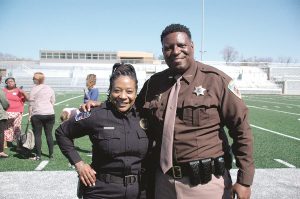
Part 2 of 2
By Jonathan Gramling
Shunta Boston, who became the assistant chief for the Sun Prairie Police Department back in October 2021, was born and raised in Milwaukee and grew up in its inner-city. And it is probably that life in the inner-city with people succeeding and others committing crime, often times in the same family tree, that has taught Boston to give people respect and dignity as she has served her communities as a police officer.
For Boston, it was more about community service than enforcement, although she could and would enforce. But it was the humanity of the people with whom she came in contact that was most important.
“The reasons why I didn’t like the police were because of the way that police would always talk to people and how they would treat them,” Boston said. “They would act like people were nothing and people were beneath them. That was always in the back of head. I always wanted to be the opposite. And that is how I always did it. It was never about the enforcement. Now if I had to enforce, I was going to enforce. But in the meantime, I’m going to communicate and walk you through the whole purpose of why they made me have to do what I was going to do., how I am bound by the law or our rules and procedures to say, ‘I have to do this. However, this is only temporary. I have to arrest you because of A, B, C and D. But remember, this is temporary. You can do something different from this point forward.’”
When Boston became district commander for District 3 in Milwaukee, a very diverse district demographically and economically, Boston could take her version of community policing beyond just her own personal approach to the way that the officers under her command would approach their work.
“As a commander, I basically was the chief of my district,” Boston said. “I got to dictate things. I got to go into the neighborhoods, talk to the businesses and residents. I got to direct my resources, my officers, my sergeants, and my community liaisons. I was the chief of my district. And the reason why was because there was a certain way that I policed and I felt that as a police department, we did okay. But we did not do a good job when it came to community policing. What I was able to do was direct my people. And not only direct them, but show them how it should be done. And so I would start to hand-pick people and have them come to some of the community meetings, have them go out with me to do park-and-walks and have them come out and do traffic stops so they could see how I did it. I got comments from them that said, ‘Hey everyone likes you, but then when we come on the scene …’ Or they will make comments about there have been times where scenes have been very chaotic, but as soon as I came on the scene, it all calmed down. The people who were yelling at them or cussing them out stopped yelling and cussing them out because I was on the scene. But I had to explain to them was that I had built a rapport with them. They didn’t trust what was going on. They didn’t understand it. And so when I came on the scene, they trusted the fact because I was on the scene, they knew that I was going to be fair with whatever was going on. And I was going to communicate with them.”
It was all about rapport and communicating that Boston — and her people — were there to make their lives better and not just to enforce “the system.”
“I literally would go door-to-door,” Boston recalled. “If we had a situation on the block and people weren’t talking to the police and didn’t want to talk with them, the next morning, I was knocking on the door. ‘We’re here to help you out. Explain to me why you aren’t talking. I get the ‘no-snitch’ rule. I get that. But shouldn’t you feel violated that these people came to your block and your house and started doing crazy stuff. And then you don’t want to say anything? That doesn’t make any sense. And that is what you are teaching your children? You’re saying that you want this cycle to continue.’ I would give them my business card. But I would have to talk with them. ‘This isn’t acceptable and it shouldn’t be acceptable. And if you allow it to be acceptable, your children are going to allow it to be acceptable. They are going to take this from where they are at. And they are going to take it to the school. And now all of these seeds that you are planting just from that one thing, eventually it will impact our entire city and your life, your family life. It doesn’t make sense to me. Do we want that?’”
After 25 years, Boston retired from the Milwaukee Police Department. But phone calls and intrigue led her to an opening for the assistant police chief position at the Sun Prairie Police Department. While checking it out, Boston was skeptical and wondered if there were even Black folks who lived in Sun Prairie. But cautiously, she checked it out as she applied and spoke to the chief.
“I put my application in, Boston said. “I came up here a couple of other times before my interview just because I didn’t want to waste any time if I wasn’t going to take it serious. And so I came up here and I liked some of the things I was hearing, especially when I talked with the chief. A lot of the things that he was talking about that he was trying to do for the community and particularly for the diverse community portions of Sun Prairie, really lines up with my own ideology and some of the things that I did in Milwaukee. After a while, I prayed on it and here I am.”
As second in command, Boston takes care of the day-to-day operation of the department.
“I’m in charge of the two bureaus and the lieutenants,” Boston said with a laugh. “I’m in charge of all of the day-to-day operations. I tell the chief, ‘You go out there and make the mayor happy and everyone else and kiss the babies and then come back and tell us what we need to do.’ He is really the director and I am the day-to-day operations person. He’s the big picture director.”
One of the biggest adjustments that Boston is trying to make is bring big city procedures to a small city police force for a city that isn’t so small anymore.
“In the city, I would go to meetings and I would be like, ‘So what did we do last time,’” Boston recalled. “Three people have a different story about what happened last time. I was like, ‘You didn’t write it down? No one prepared a document or even a debrief or after action report? Even if you didn’t write down what you did before, no one prepared an after action report? That’s the struggle of them understanding that number one, if you don’t document, it’s hard for you not to be seen as if you aren’t being biased. It’s like you changed it every time when different players were involved when truly it’s not because this person was involved. It’s because you didn’t document and now you have different players at the table and no one knows what was done last time. The people who were involved know what was done last time and then they can see that it is done differently.”
While Boston could be relaxing on a beach somewhere, she saw an opportunity to promote change and she seized the opportunity.
“You have to be the change,” Boston emphasized. “I keep hearing, ‘No one wants to be a cop. No one likes it.’ I understand that because that was me. But now that I’ve been in it for 27 years, what I would say to individuals is, ‘You cannot say you want something to change and you don’t get a seat at the table. Everyone who is talking about that they don’t like the police and they don’t like how the police aren’t doing anything and they don’t want to do the police job, they don’t have a seat at the table. You can say what you don’t like and what you would love to see the police do differently or how you want them to do it. But if you don’t have a seat at the table to explain that, then your words don’t mean anything. Even with me being at Sun Prairie, I have had to make people see things differently, even with the chief because if you aren’t a Black female, there is no way that you can make a decision for me as a Black female and know for sure that it is right if one is not at the table to say that it makes sense or they are offended by that or no Sun Prairie, you say that you are diversified and inclusive, but I can’t go to Walgreens and buy stockings that match the color of my skin. Or I can’t go get hair products unless I leave the city. So I will say to individuals. ‘Listen, you won’t be by yourself. And if you don’t like it, you can always not do it. You can leave. You can go get another job. But become part of the solution. We need you!’”
One gets the feeling that the Sun Prairie Police Department — and Sun Prairie — will never be the same due to Shunta Boston’s efforts. And that’s a good thing.
