
Fitchburg Names Its Common Council Chambers after Former Mayor Frances Huntley-Cooper: Commemorating Herstory
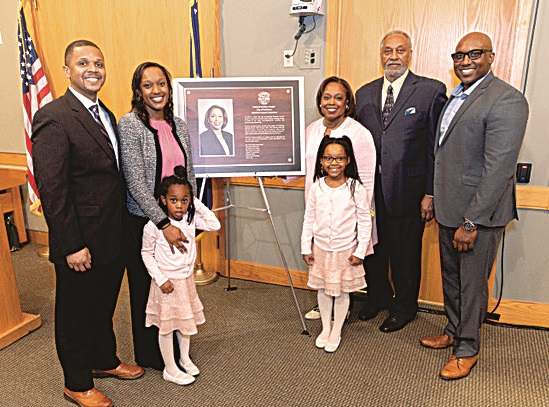
The Huntley-Cooper Family at the Common Council chambers dedication: From left to right, Jason and Hasina Davidson (daughter) with Zariah Davidson (granddaughter), Amira Davidson (granddaughter) , Mayor Frances Huntley-Cooper, Alphonso Cooper and Akil Huntley-Cooper (son)
By Jonathan Gramling, Photos by Amadou Kromah
On March 8, 2023, over 100 people turned out at the Fitchburg City Hall to participate in the official naming of Fitchburg’s Common Council chamber after former Mayor Frances Huntley-Cooper who became the first African American elected mayor in the state of Wisconsin back in 1991. And she remained the only African American-elected mayor until last year when Cavalier Johnson was elected mayor of Milwaukee. From current Governor Tony Evers and former Governor James Doyle to AKA President Stephanie Bradley Wilson, people took turns highlighting that moment in Wisconsin history, its historical impact and its continuing impact today.
When Huntley-Cooper was elected mayor, she had to do a lot of representing on several different levels both within and outside of the Black community. The issues surrounding race were always there, whether they came to the surface or not.
“I didn’t want to embarrass Black folks,” Huntley-Cooper said about being the face of the Black community in Fitchburg. “I didn’t want that when I left, people would say, ‘We don’t want another Black mayor because do you remember what she did?’ I didn’t want that hanging over the citizens of Fitchburg. I wanted them to be open minded and give other people who come after me opportunities. I wanted to keep the doors open. I think I survived with that. And I definitely didn’t want to be the one where people said, ‘Well there were money issues when she was there.’ That didn’t happen under me because I wanted to make sure that everything was clear and transparent. It was tough when I look back on it. But I just didn’t think of it at the time.”
Huntley-Cooper also didn’t want to be perceived as a “sell out,” abandoning the Black community for her own narrow political success.
“When I ran for mayor, the Black folks whom I knew were very supportive,” Huntley-Cooper observed. “We talked and we were on the same page, and had similar values. Just representing and doing the right thing from my viewpoint, I never had Black folks who said, ‘Where are you coming from? What’s up with you?’ I felt, in a sense, yes, I represented Black folks. But let’s be real.
The constituency wasn’t predominantly Black. I do not feel or even recall having a conversation where I was in terms of the Black people I knew were on different sides on an issue than me. I don’t remember anyone calling up and saying, ‘What are you thinking? What are you doing? This is going to hurt us.’ I don’t recall that ever happening.”
And most importantly, Huntley-Cooper relied upon the Black community for support as she engaged in the genteel rough and tumble nature of Fitchburg politics.
“I just felt that the Black folks I was in communication with or knew were very supportive like Carol and Bob Steele,” Huntley-Cooper said. “Oh my goodness. Bob, bless his soul, they weren’t afraid to let me know what they thought about things. And I felt very supported by the Black population in whatever I was doing. And I never heard people say, ‘Frances, we need to sit down and talk with you.’ I never felt that conversation had to happen. From the community as a whole, I had support from good Black folks although — and this is very key — I had many of the mayors from across the country say, ‘You have to watch yourself. Watch your back Frances because there will be somebody that your community will put up to run against you. They will find another Black person to run against you or speak out against you.’ I have to say while I was in office, that never happened. And I really felt like when I campaigned and the people I knew were just good Black folks. And as I said, Ed Murray may have been one that they targeted, but Ed came from Milwaukee. He met me. I don’t think you should support any and everybody just because they are Black. I think you should support them for what they stand for. And I think that my values were very similar to the Black constituents in Fitchburg. That was representative, pretty much, of the whole community.”
While she didn’t know it at the time, Huntley-Cooper’s years of work as a social worker prepared her for the sniping and negative chatter of politics.
“I began to realize that I had just developed a thick skin,” Huntley-Cooper said. “I believe that was due to me being a social worker. We have to make tough decisions about keeping children safe, whether you are going to remove a child from the home and have to go to court. I had a lot of issues that I felt there were not easy things to do or say in my workplace. That’s why I felt it trained me to deal with citizens because not everyone is going to be happy with decisions you make, whether it is the paving of the streets or whatever. You’re not going to be able to please everyone.”
When Huntley-Cooper first was elected alderwoman in 1987, Fitchburg had a female mayor and a majority of the Common Council was women. But over the next few years, all of that changed. While no one was putting a word to it, Huntley-Cooper also had to deal with the sexism of the conservative side of Fitchburg.
“I ran for reelection in 1993,” Huntley-Cooper said. “The best way to say it was the guys. There was something about me drawing an opponent to run against me. And they seemed to be white men. I was beat out by the good, old boys, Doug Morrissette. I had had a term and these people were like, ‘We need to get this woman out.’ They didn’t care as long as they got me out. That’s how I always felt in terms of what was going on. They got half of the Old Fitchburg folks to come out and run against me. I call them the ‘Good, Old Boys.’”
And it could get personal.
“When Jo Bernhardt ran, the woman who came in first for alderperson and lived down the street from me and was a very nice woman, she knocked on my door and said that people were encouraging her to run,” Huntley-Cooper said. “She wanted to check in with me first. That was an upstanding thing to do. I knew that she would be good and she was. She only did one term and said, ‘I don’t know how you do it Frances. I’m out of here.’ I really enjoyed having her on there. But there were a lot of women who just couldn’t take the attacks and abuse. That’s when I knew that my social work background helped me stay strong.”
And while there was abuse that went on, Huntley-Cooper is very proud of Fitchburg and the people who live there.
“It was nice to see that not only a woman, but a Black woman was mayor,” Huntley-Cooper said. “And none of that could have happened without having people to genuinely step outside of their comfort level. People are talking about DEI now. But Fitchburg was ahead of DEI because people just listened to what I had to say. It was based on content and not on the color of your skin. It was surprising to me because that was not my goal to even think I could do that in a predominantly white upper middle-class city. But you had educated people who lived in Fitchburg, so you go beyond the color of the skin. I think that helped me and just having the support of leaders in the community like my treasurer, Bill Conzemius, who was the principal of my daughter’s school. It was a name that people in the Seminole Hills part of Fitchburg would say when their kids went to Stoner Prairie School, ‘Who is this Black person whom you are treasurer for?’ He kept telling them who Frances really was. I had a lot of ambassadors throughout the city who believed in me. A lot of them represented different parts of Fitchburg whether it was the environmental part or public works or public safety. There were different people who were advocates or ambassadors for Frances. That’s how I was able to be elected.”
When asked about her legacy as mayor of Fitchburg, Huntley-Cooper offered up transparency, a trait that could have led to her defeat in her reelection bid because information is power and everyone became empowered.
“I think the impact that I was trying to have was to be transparent, enact good policies that impact our community in terms of planning,” Huntley-Cooper reflected. “Fitchburg was 35 sq. miles and so planning was really, really key. I wanted to make sure that the impact that I had on Fitchburg was one that would best impact the citizens of Fitchburg, all of Fitchburg and not just pockets or districts or farmers or the rural versus the urban areas of Fitchburg. I wasn’t trying to pit one group against another. I wanted to make sure we were strategic in our development conversations. And the growth and the future, we wanted to make sure that we were going in the right direction. Recycling was a big thing back in the day. We had put recycling on the map. That is history that is forgotten. I don’t know how many people realize that Fitchburg was the capital of recycling in the state of Wisconsin when I came on board. When you talk about history, it’s not just Frances Huntley-Cooper as mayor. There are a lot of things in Fitchburg that shouldn’t be forgotten. I wanted to be a role model, but I didn’t go out tooting my horn. Maybe that was a mistake in terms of why a lot of people didn’t know about it. I was busy doing the job and didn’t have time to be my own historian, archivist. I didn’t even think about that to be perfectly honest. I just thought about, ‘Let me try to do the best job I could so that I could make sure when I left that I did the best I could with what I have.’”
While she may not have known it in 1991 when she ran for Fitchburg mayor, Frances Huntley-Cooper had an impact on Fitchburg and all of Wisconsin when he became the state’s first elected African American mayor. Her legacy continues.