

Parts of Town of Madison to Be Attached to the City of Madison: South Madison Makeover
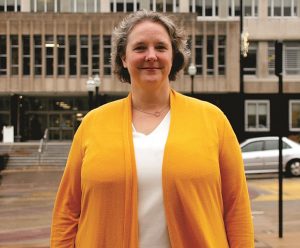
Madison Mayor Satya Rhodes-Conway is overseeing the attachment of significant portions of the Town of Madison to the city on October 31st.
Part 1 of 2
By Jonathan Gramling
While the ground will hardly shift — at least for the moment — there will be a seismic shift occurring in the broader South Madison area, as well as other parts of the Madison area, on October 31, 2022. That is when the Town of Madison will cease to exist and its assets, land and the people who live there will become part of the city of Madison or the city of Fitchburg through an agreement that was signed 20 years ago.
There are areas of South Madison that have been almost schizophrenic in nature. Within almost the same block, there have been buildings — and families — eligible for certain services and subsidies while their neighbors are ineligible because the city/town divide cuts them into different municipal boundaries. The attachment of these areas involves a lot more than changing the boundaries on a map. It could mean wholesale changes in the lives of the people who live in the Town of Madison.
“I think people don’t really realize how much local government does,” said Satya Rhodes-Conway, the mayor of Madison. “It’s everything from your garbage pick-up to repairing the streets to forestry to the parks to the fire department to building inspection. And then there are all of our community development and economic development services and access to our senior center. There is a whole broad array of things that the city of Madison provides and we will start providing to residents of the Town of Madison in November 2022. We want to make sure that people understand that and understand where to go to access the services that are available to them.”
While the state of Wisconsin has designated protected classes in terms of employment, public accommodations and other areas of life and instituted programs for underrepresented classes, the city of Madison has gone beyond the state in creating protected classes and providing additional services.
“The changes in terms of protected classes within the city is just one of the many changes,” Rhodes-Conway said. “Certainly our Civil Rights work, our Affirmative Action work and our Small Business Equity and Recovery Program that has been focused on businesses owned by women and people of color and other underrepresented classes will be new resources. If you look at some of the initiatives that we have around sustainability and climate change that will be available to the town as well. Again there is a whole broad range of things.”
Over times, infrastructure changes will happen in areas now in the Town.
“We have different standards by which we build our streets than the towns do,” Rhodes-Conway said. “There are still areas in the city of Madison where we annexed in a portion of the Town. For instance, we still have streets that don’t have curbs and gutters. That’s something that we transition over time. There will be changes in infrastructure as well as changes in the services that are available. It won’t be immediate, but we will be adding sidewalks over time.”
And along with curbs and sidewalks comes multimodal transportation and eventually how the street grid runs through South Madison. For instance, none of the streets going east-west across S. Park Street cross from the city to the Town. That may all change.
“One of our goals in all of our planning is really to think about how to best connect neighborhoods and make it easy for folks — no matter what mode of transportation they are using — to get where they need to go,” Rhodes-Conway emphasized. “Often that is about street connection. But it is also often about making sure that there are sidewalks where people want to walk or making sure that there is a bike facility that is comfortable for all ages and abilities. Or it might mean providing more transit service. I think we are really looking at all of the above. Some of those changes will happen in shorter time frames than others.”
Every 10 years after the U.S. Census information is released, governments from the local to the national go through a process of redistricting their representational units to ensure that the “one person, one vote” principle is followed. The attachment of the Town of Madison is creating a major shift in South Madison.
“One of the things that our redistricting committee took into account was the fact that we will be taking in a good chunk of the Town of Madison population,” Rhodes-Conway said. “It’s about 5,000 people. And that is significant in terms of keeping our aldermanic districts balanced. The task before that committee was to redraw the 20 districts in a way so their populations were relatively evenly balanced across the city, so that each district had about the same population. 5,000 people is about a third of a district at this point. So that is a big impact. If you had drawn those districts and then added 5,000 people to one of them, it would put things way out of whack for the next decade. And so the committee took that into account when they redrew the lines and we’ve accommodated that population growth through the attachment.”
And while it won’t be a seismic shift in the immediate, the city and the Town have different building and other standards that will eventually transform what is built in the Town area and how it is built.
“Zoning is something that our staff is looking at in the attachment process and planning for how those areas will be zoned when they get attached to the city,” Rhodes-Conway said. “I think we aren’t, at this point, planning any dramatic changes from what is existing. But that is something that we always have to look at. I expect that our zoning districts and definitions are different from what the Town has.”