


An Interview with Madison College’s Dr. Maurice Sheppard: The Impact of Trump on the U.S. Government
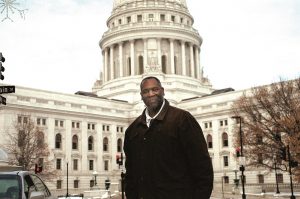
Dr. Maurice Sheppard, professor of political science at Madison College, in front of the Wisconsin State Capitol.
Part 1 of 2
By Jonathan Gramling
No matter how you feel about him, there can be no denying that former President Donald Trump had a huge impact of the federal government, almost redefining the presidency and the relationships between the executive, legislative and judicial branches of government. Even in the way that he has exacerbated the fissures in the American political landscape, Trump has wreaked havoc on the values and traditions of American federal practice to almost render them meaningless.
Take impeachment, for example. While it has historically been thought of as almost a nuclear option in terms of altering political behavior — the mere threat of it caused Richard Nixon to resign in 1974 — Trump made impeachment almost impotent.
“Quite honestly, the impeachment had little to no impact; two things just in terms of its impact on politics in how people view former President Trump and that sort of thing,” said Dr. Maurice Sheppard, a political science professor at Madison College. “I think all of that was already baked in. If you were a loyal Trump supporter, it didn’t faze you very much. If you were not in favor of former President Donald Trump, it just cemented the fact that he may be not one of the great presidents. I think it does set the floor for going forward for institutional issues. For example, if he were to try to run again in 2024, the impeachment wouldn’t prevent him from running again. But that is something that can be held against him during campaigns. But the impeachment had a muted effect. That’s the best way to put it.”
“But then those always came with a quid pro quo. ‘I appointed you to this position. Now It was the fact-finding through the impeachment process that could possibly have a greater impact.
“And there may be — who knows — additional charges coming up as the January 6th select committee continues its investigation,” Sheppard observed. “It’s not necessarily that impeachment would trigger anything. But it could very well be that some of the information that was collected during the impeachment process could lead the select committee to recommend that the Justice Department take additional action. I’m not exactly sure what that would look like. That would be new territory.”
According to Sheppard, the presidency itself is imbued with tremendous personal power that has been restrained by the tradition of presidential decorum and historical views of the role of the presidency. Those are restraints that Trump pushed to the limits and oftentimes broke through.
“What former President Trump’s administration has placed a spotlight on was something that other people have worried about for years, namely presidential power, particularly the president using the emergency powers of the president that over time, during the time of the existence of the United States, the executive branch has grown not necessarily in terms of formal Constitutional power, but the power that it actually exercises,” Sheppard said. “Up until former President Trump, quite honestly — this is my own assessment — we’ve been lucky to have presidents who have not exploited the extensive power that a single individual in the U.S. government constitutionally has. And I think it was former President Trump who is the person who exploited all of those informal checks on power that restricted the actions of previous presidents. With former President Trump, he threw all of those informal checks of presidential power out the window. He exploited all of those to his advantage. To the extent that he tried to exploit those was to overturn the presidential election.”
Historically, federal agencies and departments have had relative autonomy in pursuing the goals and mission of the department as specified or implied by federal statutes. While the political appointees who headed the departments would try to steer the bureaucracy according to their own political agenda, the bulk of the departments’ work would carry on relatively untouched by direct political manipulation. But that changed under Trump.
“The Department of Justice — just like any other federal agency — falls under the supervision of the president,” Sheppard said. “The president is in charge of public government administration, the bureaucracy. I think what former President Trump did — not just with Justice, but with other agencies as well — was flex his administrative muscle, his constitutional muscle, to try, especially when it came to overturning the 2020 presidential election, to change the behavior of government bureaucratic officials. Again the Justice Department is probably the single clearest example of that in terms of appointing people to positions that he thought would be supportive of his positions and also his behavior of engaging people in the Justice Department and treating them in ways that would put them in fear of losing their job and their livelihood. As a president, he charted new territory there in terms of how he used the bureaucracy and the administrative apparatus of government.”
In essence, the maxim, “We’ve always done it this way” had no impact on Trump as he was implementing his campaign promise that he would shake up Washington.
“For any political leader, you have the formal rules of the game and then the informal rules of the game,” Sheppard emphasized. “The formal rules of the game are the expressed powers of the president in the Constitution like commander-in-chief, domestic policy, foreign policy and that sort of thing. But there is also the informal power that a president holds. For former President Donald Trump, again, he knew about the informal powers. But he did not understand or care about how he used those. As I mentioned, previous presidents would look at the informal power of the president and they would understand that those powers could only extend so far and should only extend so far. They were not to be extended to the point that they would threaten American democracy. Former President Trump, if he knew of those informal powers, he didn’t care about that.”
While political life in Washington is driven by “log rolling” where politicians will vote on one person’s bill in exchange for that person’s vote on another, Trump made it almost personally transactional, a method he has used his entire life.
“In his informal role as head of the Republican Party, he exploited that to his advantage in terms of giving Republicans within the party certain positions in the White House and appointed to particular jobs,” Sheppard said. “But then those always came with a quid pro quo. ‘I appointed you to this position. Now

it’s time for the payback.’ That’s exactly what he did during the lead up to and on January 6th with the storming of the U.S. Capitol. What is coming out now through the January 6 select committee is he said to Vice-President Pence, ‘I made you. You will do what I tell you.’ It was Pence and his desire not to destroy this country and create a constitutional crisis that he didn’t follow through on the plan to not certify the electoral vote.”
Traditionally, presidents have viewed the power of the president as a tool to pursue the best interests and goals of the country. Personal power was a means and not an ends. Trump turned that notion on its head.
“I think President Biden put it best today when he said former President Trump put power over everything else,” Sheppard said referring to Biden’s January 6th speech. “Former President Trump views every relationship as quid pro quo. I think he also views relationships — I’m saying this in hindsight now — through a spectrum of a power dynamic. How much power does he have? In hindsight now, he didn’t really care that much about money when you see how many times he filed for bankruptcy, business bankruptcy and that sort of thing. It seems like the events that led up to January 6th show that what he was more concerned with was power, power over individuals and what his position was vis a vis someone else. He always had to be on top. He views his relationship as president to everyone else as being above them. Even if he nominates someone for the Supreme Court and that person goes through the confirmation process, he views it as ‘they owe me’ just like he viewed his relationship with Mike Pence.”
Everything was transactional for Trump. There was no greater good beyond his own.
Next issue: The exercise and non-exercise of presidential power
